
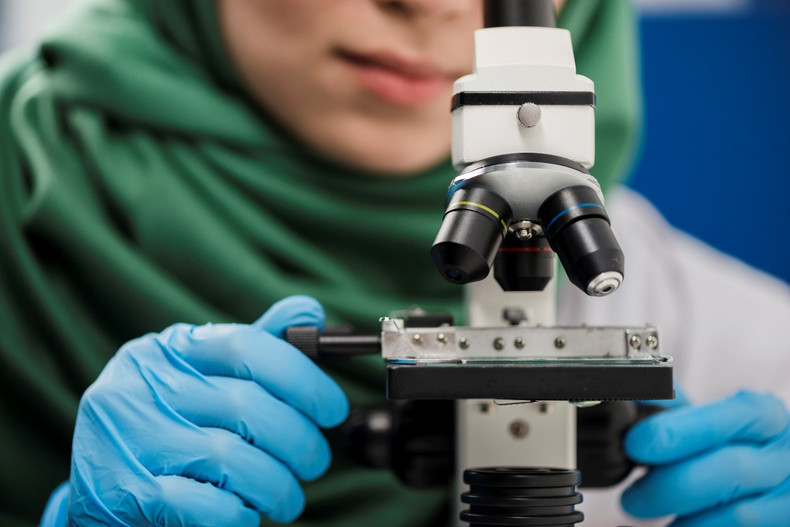
Buying a microscope is easier than ever, with plenty of suppliers offering a wide selection of models at competitive prices. At Steede Medical, you can even take advantage of flexible payment plans to purchase quality equipment without putting too much pressure on your budget. You’ll also find trusted microscope brands like Olympus in our product range.
With so many options available, choosing the right equipment from microscope suppliers isn’t always easy. Since it’s an important investment for your laboratory or practice, it’s worth taking the time to understand what features matter most before you make a decision.
What should you look for in a microscope?
The right choice depends on what you’ll be examining, so it’s important to understand a few basics before you buy.
Understand how magnification works
Magnification comes from two parts of the microscope: the objective lens and the eyepiece lens. To calculate the total magnification, simply multiply the magnification of the objective lens by that of the eyepiece. So if you're using a standard 10x eyepiece with a 100x objective lens, you'll get a total magnification of 1,000x.
More magnification isn’t necessarily better
It's easy to think that the microscope with the highest magnification is automatically the best choice, but that's not usually the case. So, don’t be fooled by microscope suppliers who make claims that higher is always better.
Most light microscope applications require less than 60x magnification. Instead of focusing on the biggest number, think about the level of magnification your work actually requires. This also ensures that you’re investing in the right microscope without overspending on features you won’t actually use.
Choose between a compound or stereo microscope
You should also consider what you’ll be looking at with your microscope.
If you're examining small specimens such as blood samples and microorganisms, you'll need a compound microscope. These are high-power microscopes that typically include three to five objective lenses ranging from 4x to 100x.
On the other hand, you may find a stereo microscope useful if you're working with larger specimens like insects and leaves. These generally offer magnification from 6.5x to 45x and use two eyepieces to produce a three-dimensional view, so you can easily observe larger objects in detail.
Pay attention to optical quality
Many quality microscopes use achromatic objective lenses, which help correct color distortion caused by different wavelengths of light. If your work requires exceptionally flat images across the entire field of view, you may also want to consider plan objectives.
It's also worth checking with microscope suppliers if their devices use DIN-compatible objectives. This allows you to use compatible objective lenses interchangeably with other DIN-compatible microscopes, so you can scale up or down as your observation needs change.
For more advanced imaging applications, microscopes like the Olympus BX53 include fluorescence illuminators with a fly-eye lens that gives you even illumination across the visible spectrum. Its motorized universal condenser also helps reduce back reflections and autofluorescence during fluorescence imaging by automatically adjusting the condenser position and diaphragm.
Consider the illumination system
Many microscope suppliers today offer modern devices that use LED illumination instead of traditional halogen lighting. You may even appreciate how LEDs provide consistent brightness and have a much longer service life.
With the Olympus BX53, you even benefit from an LED illuminator that delivers brightness comparable to, or greater than, a 100-watt halogen lamp. It also produces color characteristics similar to halogen lighting, so you can easily distinguish important purple or cyan and pink tones commonly used in clinical research.
Biological microscopes such as the Olympus CX43 and CX33 also feature LED illumination with fixed Köhler illumination. This can help you achieve proper lighting without needing to adjust the condenser manually.
Shop microscopes online
Make sure you’re buying equipment from reputable microscope suppliers like Steede Medical. Here, we make it easy for you to find the right device from our up-to-date catalog of Olympus microscopes.
If you need a quote or help comparing products, give us a call at 305-597-0607 and we’ll assist you.