
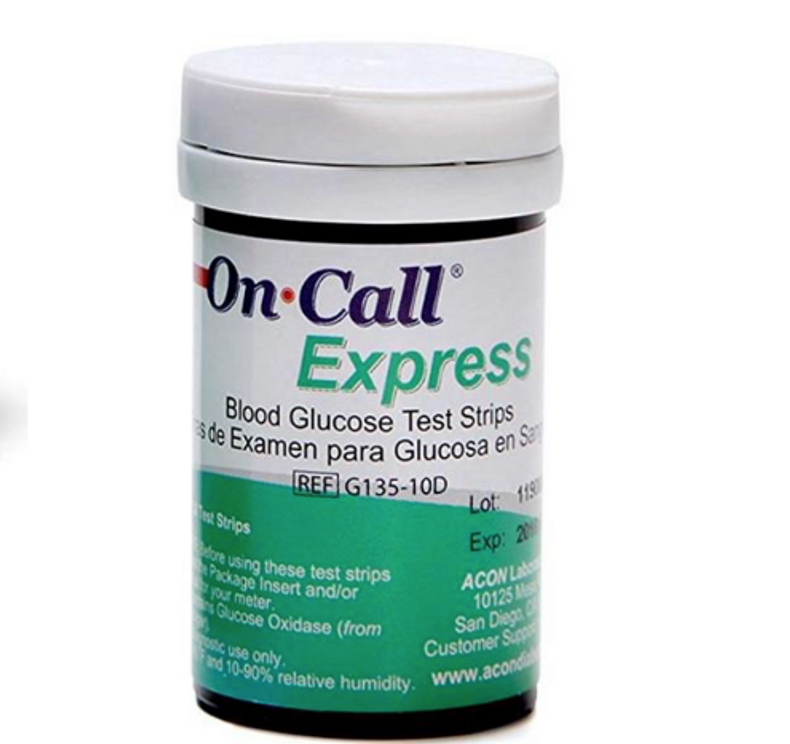
Checking your blood sugar is one of the most important parts of managing diabetes, especially if you take insulin or have type 1 diabetes. A meter is only as good as the strips you use with it, so it pays to pick a system that's easy to use and gives readings you can trust. At Steede Medical we stock ACON's On Call Express system: the On Call Express meter, On Call Express test strips and the GLUCO-CARE safety lancets that go with them.
This guide explains how On Call Express test strips work, how to get accurate readings, when to test, and what to know before you order.
About On Call Express test strips
A glucometer reads your blood sugar from a small drop of blood on a test strip, so the strip and the meter have to be made for each other. On Call Express strips work only with the On Call Express meter.
- There's no coding. Each strip has auto-calibration built in, so there's no code chip or number to enter before you test.
- The strip needs just 0.4 microliters of blood, a very small drop.
- The meter shows your reading in about 4 seconds.
- If the first drop is too small, the meter's Audible Fill detection lets you know, and you can add a second drop within 3 seconds instead of wasting the strip.
- You can test with blood from your fingertip, palm or forearm (see below for when to use each).
How to get accurate readings
- Wash your hands with soap and water, then dry them fully. Food, lotion or water on the skin can change the result.
- Take one strip out and close the vial straight away so the rest stay dry.
- Use a fresh lancet every time. GLUCO-CARE safety lancets are single use, 21G with a 1.8 mm depth, and come 100 to a box.
- Prick the side of your fingertip rather than the pad.
- Make sure the drop fully covers the strip's sample area.
- Keep the meter clean, and note down each reading so you and your doctor can spot patterns.
Fingertip, palm or forearm?
Use the palm or forearm only when your blood sugar is steady, for example before a meal. Test on a fingertip after a meal, after exercise, when you feel unwell, or when the reading will guide an insulin dose. When your sugar is changing quickly, blood from the palm or forearm can lag behind the fingertip.
Best times to test
Your doctor can tell you the best times to check your blood sugar with your meter and On Call Express test strips. It's also wise to test whenever you have symptoms of high or low blood sugar. Common times to test are:
- When you wake up
- Before meals
- 2 hours after meals
- Before and after exercise
- Before bed
How often should you test blood sugar levels?
That depends on the type of diabetes you have, the medication you take, your lifestyle and your overall health, so your doctor is the right person to set it. Healthcare providers often recommend more frequent checks for people who:
- Are pregnant
- Have just had surgery
- Take insulin
- Have frequent low blood sugar, with or without warning signs
- Are struggling to reach their blood sugar targets
- Are ill
Why the right test strips matter
Regular checks show you how food, activity and medication affect your levels, but only if the readings are right. Strips that have been stored badly, are past their date, or come from an unknown source can give wrong results. Buy from a supplier you trust, check the expiry date on each box, and keep the vial closed and away from heat and damp.
Ordering On Call Express test strips from Steede Medical
The strips come 50 to a box, with a minimum order of 4 boxes, so you're stocked for a while. Shipping is free on our diabetic supplies, and orders ship within 1–2 business days. You'll find the meter, strips and lancets together in our diabetic supplies range. For larger or repeat orders for a clinic, care home or school nurse's office, call 305-597-0607 or email contact@steedemedical.com.
This article is general information, not medical advice. Your doctor or diabetes care team can tell you how often to test and what your targets should be.